Running a music school is one of the most rewarding things you can do with a life in music. You get to watch students fall in love with an instrument, build something genuinely yours, and — if you get the business side right — earn a very good living from it.
But here's the truth that nobody tells you at music college: running a music school is only about 30% music. The rest is scheduling, invoicing, chasing payments, managing teachers, communicating with parents, tracking attendance, handling cancellations, and a hundred other admin tasks that have nothing to do with crotchets and quavers.
This guide covers everything you need to know about the business of running a music school in the UK. Whether you're a solo teacher thinking about scaling up, or you already run a multi-teacher academy and want to tighten your operations, this is the resource we wish had existed when we started building LessonLoop.
Define your vision before you do anything else
Every successful music school starts with clarity about what it's trying to be. This matters more than your logo, your website, or your choice of accounting software. It shapes every decision that follows.
Ask yourself these questions before you spend a penny:
What instruments and styles will you teach? Some schools specialise in classical piano and strings with a clear ABRSM/Trinity grading pathway. Others focus on contemporary instruments — guitar, drums, vocals — with a more informal, performance-oriented approach. Multi-discipline schools that cover everything from violin to music production need fundamentally different scheduling, staffing and room setups. Pick your lane first.
Who are your students? Children aged 5–18 make up the majority of private music school students in the UK. But adult learners are a growing and underserved segment. Your target age group affects everything: your lesson lengths (20 minutes for young beginners vs 45–60 minutes for adults), your marketing channels (school gate vs Instagram), and your communication approach (parent portal vs direct messaging).
What's your teaching model? One-to-one lessons are the traditional approach and command the highest per-student revenue. Group lessons (typically 2–4 students) are more efficient for the school and more social for students, but harder to schedule. Ensemble work, workshops and holiday courses add variety and retention. Most successful schools blend all three.
What geographical area will you serve? A school in a market town has different dynamics to one in a London borough. Think about competition, demographics, venue availability and travel distances for families. If you're planning multiple locations, factor in teacher travel time and the complexity of managing parallel timetables.
Choose the right business structure
In the UK, most music schools operate as either a sole trader or a limited company. Your choice affects your tax position, personal liability and administrative burden.
Sole trader is the simplest option. You register with HMRC for self-assessment and you're up and running. There's minimal paperwork and you keep all profits after tax. The downside is unlimited personal liability — if the business runs into trouble, your personal assets are at risk. Most solo teachers start here.
Limited company creates a separate legal entity. You'll need to register with Companies House, file annual accounts and operate PAYE if you pay yourself a salary. The benefits are limited liability, potential tax efficiency at higher profits (through a salary/dividend split), and a more professional image. Multi-teacher academies with significant revenue usually benefit from incorporating.
Whichever structure you choose, you'll need:
- Public liability insurance — essential if students visit your premises or you visit theirs
- Professional indemnity insurance — covers you against claims of negligent advice or instruction
- Enhanced DBS checks — legally required for anyone working with children in a regulated activity
- ICO registration — if you process personal data (you do), you'll need to register with the Information Commissioner's Office. It costs £40/year for most small organisations
Set your pricing and billing model
Pricing is where many music school owners either leave money on the table or accidentally price themselves out of their local market. You need to find the sweet spot between what your area can bear, what your qualifications and experience justify, and what makes the business financially viable.
The UK market broadly operates on three models:
Per-lesson billing is the simplest to understand. Students pay for each lesson individually, usually in advance. It's flexible for families but creates unpredictable revenue for you and makes your cash flow lumpy.
Termly billing is the UK standard for established music schools. Students commit to a term (typically 10–13 weeks), pay upfront or in instalments, and attend weekly lessons. This model gives you predictable revenue, better retention and fewer cancellations. It aligns with the school calendar, which parents already understand.
Package billing offers a set number of lessons (e.g., 10 or 20) that students use within a timeframe. It's a middle ground that works well for adult learners and casual students.
We've written a detailed breakdown of each model — including how to set your rates, handle discounts for siblings, and structure payment plans — in our music school pricing strategies guide.
Whatever model you choose, automating your billing is non-negotiable once you have more than about 15 students. Manual invoicing is the single biggest time drain in music school admin.
Build your teaching team
If you're a solo teacher, skip this section for now — but bookmark it, because if things go well, you'll be back.
The moment you can't take on any more students yourself, you face a decision: turn students away (and leave money on the table) or hire other teachers (and become a business owner, not just a teacher). Most school owners describe this as the hardest transition they've ever made.
Here's what to look for when hiring:
Teaching ability over performance credentials. A Grade 8 distinction or a music degree doesn't automatically make someone a good teacher. Look for patience, adaptability, the ability to explain concepts at a beginner's level, and genuine enthusiasm for seeing students progress. Trial lessons with existing students (with parent consent) are the best interview technique.
Reliability above everything. A brilliant teacher who cancels frequently, turns up late or doesn't communicate well with parents will cost you students. In music education, consistency builds trust and trust drives retention.
Cultural fit with your school. If your school emphasises ABRSM exam preparation, a teacher who only wants to teach rock guitar by ear isn't the right fit — and vice versa. Be clear about your school's approach upfront.
DBS checks and references are mandatory, not optional. Every teacher who works with children needs an enhanced DBS check. This is a legal requirement, and the reputational risk of getting this wrong is catastrophic.
Once you've hired, you need systems. Teacher scheduling, availability management, pay rate tracking, and role-based permissions become essential. Our full guide to hiring and onboarding music teachers covers the entire process.
Get your scheduling right
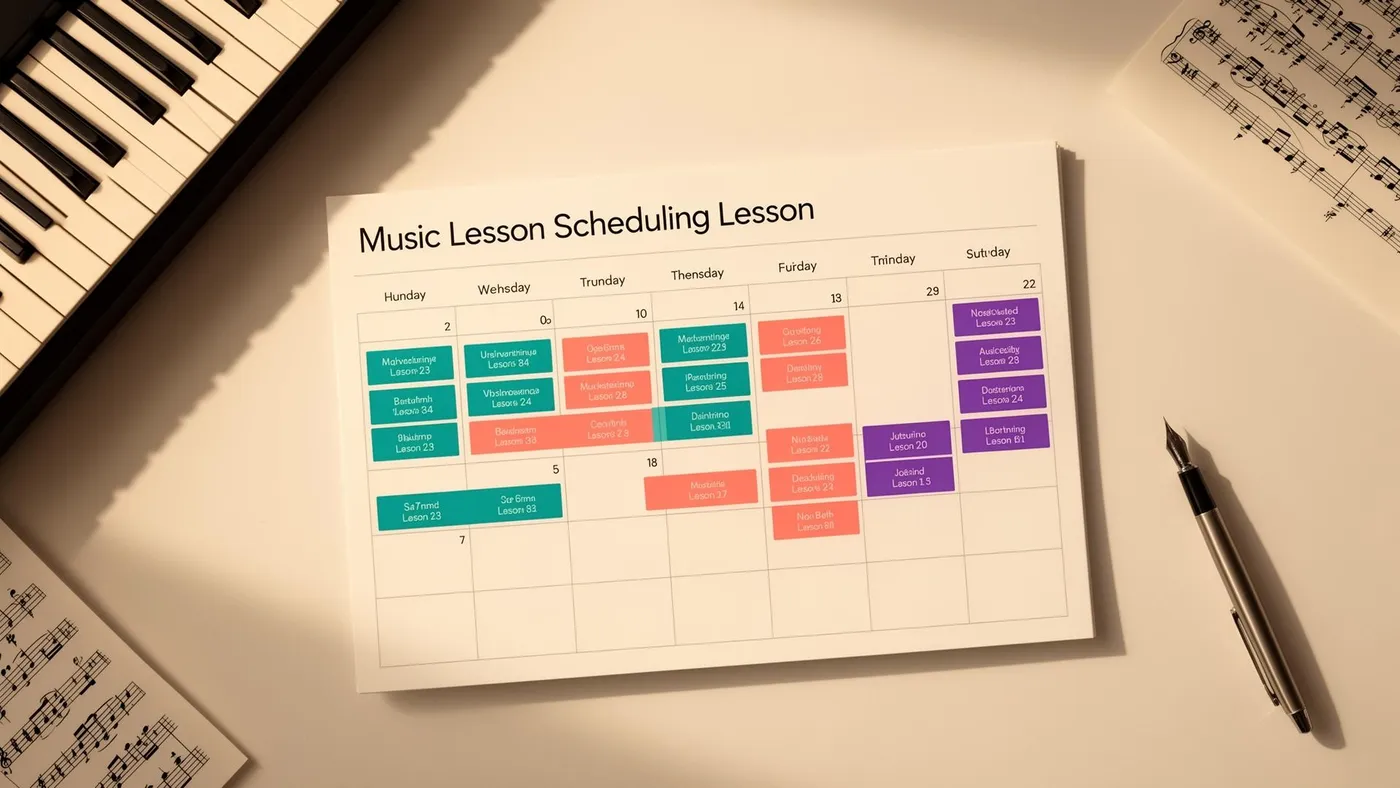
If billing is the biggest admin headache, scheduling is a close second. A music school timetable is a living puzzle — teacher availability, student preferences, room capacity, instrument requirements and term dates all have to align.
The fundamentals of good music school scheduling:
Start with teacher availability, not student demand. Define when each teacher can work, then fill slots from there. Trying to accommodate every student's first-choice time leads to a timetable full of holes.
Use recurring lessons as your foundation. The majority of your timetable should be weekly recurring lessons at the same time and day. This creates rhythm for students, predictability for teachers, and a stable base to build on.
Build in buffer time. Five-minute gaps between lessons prevent the inevitable overrun from creating a cascade of delays. Teachers need time to write lesson notes, and students need time to pack up.
Have a clear cancellation and make-up policy. Cancellations are inevitable, but how you handle them defines your revenue stability. The best approach is a written policy shared with every parent at enrolment: 24-hour minimum notice for cancellations, make-up lessons offered where possible, no refunds for no-shows.
Don't schedule manually once you're past 30 students. Spreadsheets and paper diaries work for very small operations, but they break quickly. A missed lesson, a double-booked room, or a scheduling conflict that nobody noticed until a student turns up — these are the moments that erode trust. Purpose-built scheduling software pays for itself in saved time and prevented mistakes.
Communicate with parents like a professional
Parent communication is the most underrated skill in music school management. Get it right and you'll have a school full of loyal families who refer their friends. Get it wrong and you'll spend your evenings answering the same questions over and over on WhatsApp.
The key principle: proactive communication prevents reactive admin. If parents know what's happening before they need to ask, they don't ask.
This means:
- Term dates published well in advance — ideally before the previous term ends
- Lesson schedules accessible online — not on a piece of paper that gets lost in a school bag
- Progress updates after every lesson — even brief notes show parents their money is being well spent
- Invoice transparency — parents should be able to see exactly what they've been charged and what they owe
- A single channel for questions — not a mix of WhatsApp, email, text and phone calls
The most efficient way to handle this is through a parent portal — a single login where families can see schedules, lesson notes, invoices, and send messages. It sounds like a luxury, but schools that implement one consistently report a 50–60% reduction in inbound queries.
Track the numbers that matter
You can't improve what you don't measure. Yet most music school owners run on instinct rather than data. They know they're "busy" but can't tell you their student retention rate, their revenue per teacher, or whether last term was actually more profitable than the one before.
These are the metrics every music school owner should track:
Student retention rate — what percentage of students re-enrol each term? Anything above 85% is healthy. Below 75% means you have a problem.
Revenue per teacher per month — this tells you whether your teachers are fully utilised or if you're paying for empty slots.
Attendance rate — consistent attendance correlates strongly with retention. If a student's attendance drops, they're likely to leave within two terms.
Average revenue per student — helps you understand the lifetime value of each student and whether your pricing is working.
Enquiry-to-enrolment conversion rate — how many people who contact you actually sign up? If this is below 50%, your onboarding process needs attention.
Outstanding invoices — how much money is sitting unpaid? And for how long?
Teacher utilisation rate — what percentage of available teaching slots are filled?
Net Promoter Score — would your families recommend you? A simple question that tells you everything.
We go deeper on each of these in our music school KPIs guide, including benchmarks and how to calculate them.
The good news: you don't need a data analyst. A music school management platform with built-in reporting handles this automatically. LoopAssist, our AI copilot, can answer questions like "what's my retention rate this term?" or "which teacher has the most outstanding invoices?" in natural language.
Stop doing admin and start growing
Here's the pattern we see over and over: a music school owner starts with a handful of students, manages everything in their head or on a spreadsheet, and it works fine. They grow to 30–40 students and start spending more time on admin than teaching. They hit 60–80 students and the admin becomes a second job. By the time they have 100+ students across multiple teachers, they're working evenings and weekends just to keep the invoices straight and the timetable updated.
The solution isn't to work harder. It's to systematise.
Every hour you spend on manual scheduling, invoicing, attendance tracking and parent communication is an hour you're not spending on the things that actually grow your school: teaching quality, marketing, teacher development, and student experience.
The real cost of running on spreadsheets isn't just the time — it's the opportunities you miss, the students who slip through the cracks, and the mental load of keeping it all in your head.
Purpose-built music school management software exists precisely to solve this. Not generic booking systems, not accounting software with a calendar bolted on — platforms designed specifically for the way music schools operate: termly billing cycles, recurring lessons with holiday skipping, make-up lesson management, parent portals, attendance tracking, and teacher management.
Scaling: from solo teacher to multi-location academy
Growth in a music school isn't linear. It happens in stages, and each stage requires different systems and skills.
Stage 1: Solo teacher (1–30 students). You do everything. Teaching, scheduling, billing, marketing. A simple tool or even a well-organised spreadsheet can work here. Focus on building your reputation and getting your first referrals.
Stage 2: First hire (30–60 students). You bring on another teacher, either as a self-employed contractor or an employee. Suddenly you need to manage someone else's schedule, track their hours, handle their pay, and ensure quality across lessons you're not teaching. This is where teacher management tools become essential.
Stage 3: Academy mode (60–150 students). You have 3–5 teachers, possibly a second location, and you're spending more time managing than teaching. You need proper systems: automated billing, a shared calendar, a parent portal, and reporting. You're now running a business, not just teaching music.
Stage 4: Multi-location growth (150+ students). Multiple venues, 5+ teachers, potentially admin staff. You need multi-location management, role-based permissions, payroll tracking, and data-driven decision making. This is where AI-powered tools start saving significant time.
Our guide to growing your music school from 50 to 200+ students covers the tactical strategies for each stage.
The bottom line
Running a music school in the UK is a genuine business opportunity. The demand for quality music education is strong, the market is fragmented (no single provider dominates), and parents are willing to pay premium rates for excellent teaching and a professional experience.
But the schools that thrive aren't just the ones with the best teachers. They're the ones with the best systems. The ones that bill on time, schedule without errors, communicate proactively with parents, track the metrics that matter, and free up their owners to focus on growth rather than admin.
That's what LessonLoop was built to do. Start your free 30-day trial and see how much simpler running a music school can be.
Frequently Asked Questions
How much does it cost to start a music school in the UK?
Starting costs vary enormously depending on your model. A solo teacher working from home or travelling to students can start for under £500 (DBS check, insurance, basic marketing). Renting a dedicated space typically adds £500–£2,000/month depending on location. A multi-room academy with soundproofing, instruments and equipment could require £10,000–£50,000+ in setup costs. The most common approach is to start small — teach from home or a rented room — and reinvest profits as you grow.
Do I need qualifications to run a music school in the UK?
There's no legal requirement for specific music qualifications to run a private music school in the UK. However, you will need an enhanced DBS check if you work with children, public liability insurance, and ICO registration for data protection. Qualifications (ABRSM diplomas, music degrees, PGCE) build credibility and trust with parents, and some parents specifically look for qualified teachers — particularly for exam preparation.
How many students can one music teacher handle?
A full-time music teacher offering 30-minute lessons can typically teach 25–30 students per week (allowing for breaks, admin time and setup). If you offer longer lessons (45–60 minutes), the number drops to 15–20. Most teachers who also handle some admin or management cap at around 20 teaching hours per week to prevent burnout. As your school grows, the focus should shift from maximising your own teaching hours to building a team.
What's the best billing model for a UK music school?
Termly billing is the standard for established UK music schools and is generally the best model for predictable revenue. Students (or their parents) commit to a full term of lessons, typically 10–13 weeks, and pay upfront or in instalments. This reduces cancellations, improves retention and makes cash flow predictable. Per-lesson billing can work for casual adult learners or trial periods, but it creates unpredictable income.
When should I switch from spreadsheets to music school software?
Most school owners find that spreadsheets become unmanageable somewhere between 20 and 40 students. The tipping point is usually when you experience your first double-booking, lose track of an unpaid invoice, or realise you're spending more than an hour a day on admin. If you're already past that point, switching to purpose-built software will save you significant time immediately.
Tags